Why Every Property Investor Should Consider a 30 June 2026 Valuation

Of all the planning strategies emerging from the 2026 Federal Budget, this one may be the easiest to overlook.

And potentially one of the most valuable.

The transition problem

If the proposed capital gains tax reforms proceed, assets held before 1 July 2027 are expected to receive transitional treatment.

That means gains on long-held assets may need to be split between the pre-reform and post-reform regimes.

To do that, you need a dividing line.

That dividing line is value.

What was the asset worth at or around the transition date?

Why obtaining a valuation may matter

Many investors assume they can reconstruct asset values years down the track.

In practice, that’s often harder than it sounds.

Comparable sales become harder to source. Market conditions evolve. Records disappear. Professional valuers can only work with the evidence available at the time.

For investors holding significant assets — including investment properties, commercial property, business real property and large share portfolios — maintaining reliable evidence of market value may become increasingly important if the proposed capital gains tax reforms proceed.

While the final legislative design is not yet known, investors should monitor developments closely, as future transitional rules may place greater importance on establishing asset values around any commencement date.

Who should consider this

A valuation strategy is particularly worth considering if you hold:

• Residential investment property
• Commercial or industrial property
• Development sites or rural land
• Significant share portfolios with embedded capital gains
• Business assets with substantial unrealised growth

A reminder on timing

These reforms are not yet law.

We’re not suggesting anyone make rushed decisions or incur unnecessary costs based on proposals that may change.

But obtaining a valuation is a low-cost, low-risk step that may save substantial complexity later.

The best time to prepare is before the gate closes. And 30 June 2026 is closer than it might feel.

Want to talk through what this means for your situation? We’re always only one call away.

Book a conversation with the Lighthouse team → hello@lha.au · 02 9055 1330
Property Held Personally, Through a Family Protection Trust or SMSF: Which Structure Wins?

It’s one of the most common questions we hear.

“What’s the best structure to hold investment property?”

And the honest answer, as always, is: it depends.

But the 2026 Federal Budget has made the conversation more interesting.

Personal ownership

Holding property in your own name is the simplest approach.

You have direct control, straightforward borrowing access, and — under current rules — the 50% CGT discount for assets held longer than twelve months.

The proposed CGT reforms from 1 July 2027 may change the discount structure. Negative gearing on established residential property acquired after 12 May 2026 may become restricted.

Personal ownership remains valid. But its relative advantages may shift.

Family Protection Trust

A well-structured Family Protection Trust offers genuine flexibility: income distribution across beneficiaries, asset protection from creditors and family law risk, and long-term succession planning.

The Trust doesn’t just hold assets. It protects what your family has built — from the unexpected as much as from unnecessary tax.

The proposed 30% minimum distribution tax from 2028 may reduce the tax advantages of certain income-splitting strategies. But the protective benefits — which are often more valuable than the tax outcomes — remain strong.

Self-Managed Super Fund

An SMSF can offer exceptional long-term tax outcomes, particularly for assets held to retirement.

Accumulation-phase earnings are taxed at 15%. In pension phase, income and capital gains can be entirely tax-free.

The proposed Budget reforms largely bypass complying superannuation funds. While Family Protection Trusts and personal property strategies face proposed reform, the SMSF environment remains broadly intact.

That matters.

So which structure wins?

None of them. All of them.

The strongest families rarely hold all their wealth in a single structure. They build layered defences — personal assets, trust-held assets, super-held assets — each serving a purpose.

The Budget provides a timely reason to review which assets sit where.

Not because the rules have changed yet. But because understanding your position clearly — before the rules change — is always the better strategy.

That’s exactly the kind of review we help clients work through.

Want to talk through what this means for your situation? We’re always only one call away.

Book a conversation with the Lighthouse team → hello@lha.au · 02 9055 1330

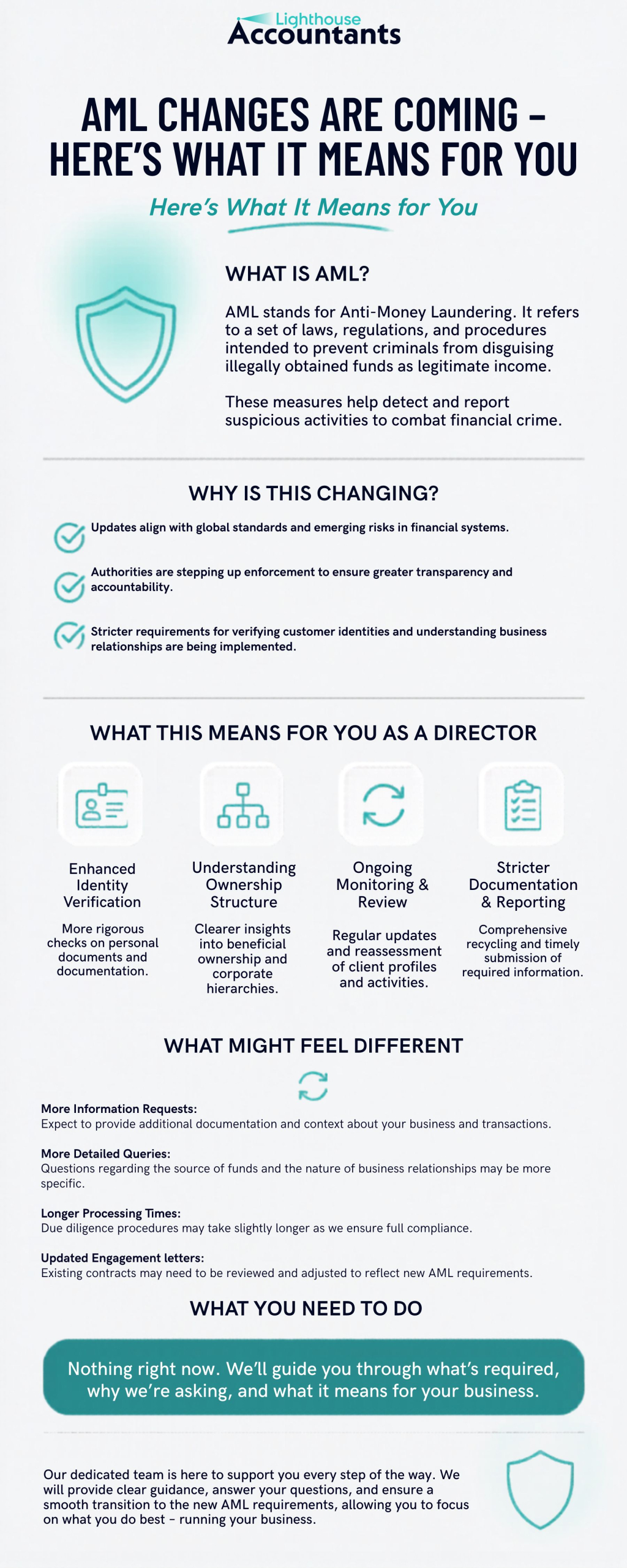
AML Changes Are Coming

From 1 July 2026, Australia’s Anti-Money Laundering (AML) landscape is expanding – and for many business owners, this will be the first time it directly touches their world.

If you’re a Director, this isn’t something to panic about.

But it is something to understand.

Because like most compliance shifts, it’s not just about ticking a box – it’s about how your business shows up, operates, and builds trust in an evolving environment.

So, what’s actually changing?

The government, through AUSTRAC, is extending AML obligations to more professions – including accountants, lawyers, and advisers.

That means businesses like ours will have new responsibilities around:

  • Verifying client identity
  • Understanding ownership structures
  • Assessing risk
  • Monitoring and documenting certain activities

You might hear this referred to as “Tranche 2” reforms.

Behind the scenes, it’s about strengthening Australia’s ability to prevent financial crime.

Why this matters to you as a Director

Even though these obligations sit with us as your advisor, they will impact you in a few key ways.

1. More questions upfront

We’ll need to collect and verify more information – especially around:

  • Who ultimately owns and controls your entities
  • How your structure operates
  • The purpose behind certain transactions or arrangements

This might feel repetitive at times – but it’s about building a clear, documented picture.

2. Formalised processes

Things that may have previously been handled informally will now be more structured.

For example:

  • ID verification will be more rigorous
  • Certain advice or transactions may require documented rationale
  • Risk assessments will become part of onboarding and ongoing work

3. Ongoing monitoring

AML isn’t a “set and forget” exercise.

We’ll be required to:

  • Keep information up to date
  • Reassess risk over time
  • Maintain records of decisions and interactions

What won’t change

This is important.

Your relationship with us doesn’t become transactional or rigid.

If anything, it becomes more intentional.

We’re still here to:

  • Guide you through decisions
  • Simplify complexity
  • Help you build and protect what you’ve worked hard for

The difference is – we’ll now have a stronger framework sitting behind that advice.

What we’re doing at Lighthouse

We’re already preparing.

Behind the scenes, we’re:

  • Building our AML framework and processes
  • Training our team
  • Reviewing how we onboard and work with clients
  • Updating engagement terms to reflect these changes

Not perfectly. Not all at once.

But thoughtfully.

Because this isn’t just a compliance shift – it’s a change in how our profession operates.

What you need to do right now

At this stage, nothing urgent.

But over the coming months, you can expect:

  • Requests for additional information
  • Updates to engagement letters
  • Slight changes in how we ask questions or document advice

Our goal is to make this as seamless as possible for you.

We’re navigating this with you

You don’t need to know all the rules – that’s our role.

We’ll interpret what’s changing, translate what it means for you, and guide you through it with clarity and confidence.

As things evolve, we’ll keep you informed and take it step by step, together.

Because in a changing landscape, the right support isn’t just helpful – it’s everything.


Sally Freeman Stevie Awards Finalist – Digital Transformation

Sydney, Australia – September 18, 2025

Sally Freeman, Business & Practice Director of Lighthouse Accountants, has been named a Stevie Awards finalist for Digital Transformation in the 2025 Women in Business Awards.

This recognition highlights how a boutique Sydney firm can embrace automation, AI, and cybersecurity while keeping client care at the centre.

Driving Digital Transformation in Accounting

Since March 2024, Sally has led a wide range of projects that reshaped how Lighthouse Accountants works. She introduced a secure client portal, now used by 97% of clients, which allows safe document exchange and task communication. She also automated invoicing, onboarding, and reporting, saving hours of manual effort every week.

Sally implemented advanced protections through Practice Protect giving the team enterprise-level controls such as phishing detection, login monitoring, and user-based app permissions. In addition, she rolled out AI transcription using Fireflies capturing more than 490 client meetings and saving five hours of note-taking each week.

These changes reduced administration time by 40% and gave clients faster, more secure interactions with their accountants.

People and Innovation Together

“Digital transformation is not only about technology,” Sally explains. “It is also about supporting staff and giving clients confidence that their data is safe.” Her approach balanced technical upgrades with flexibility for staff, training opportunities, and a culture of innovation.

Recognition on the Global Stage

The Stevie Awards for Women in Business celebrate women executives and entrepreneurs worldwide. Winners will be announced in New York on November 10, where Gold, Silver, and Bronze awards will be revealed. You can see the full list of finalists on the Stevie Awards website

FAQ

What are the Stevie Awards?
They are international business awards recognising excellence across industries. More than 12,000 entries are received each year from over 70 countries.

Why was Sally Freeman recognised?
She transformed Lighthouse Accountants by introducing automation, AI, and cybersecurity tools, normally only seen in larger firms. These changes saved time, reduced risks, and improved client service.

Protect Your Small Business From Cyber Attack